| Main page |
| New visitors |
| Buyer's guide |
| The instruments |
| Technique |
| Lessons |
| Performers |
| Recordings |
| Books |
| Forum |
| Links |
| Site map |
| Site last updated . This particular page was created 16/11/2003 and last updated 28/08/2004 Site updates |
| This site is sponsored by: Apollo's Axes Barnes & Noble.com Jingoloba Music123 Musician's Friend Sheet Music Plus |
So far we've played no more than two chords during each beat. Sometimes we want to play triplets - three chords on a beat:

Play the triplets either with down-up-down (as notated here) or down-down-up and try to return to the regular picking pattern immediately.
Upstroke after the triplet
No matter how we pick the triplet, we end up with two downstrokes immediately after each other. Sometimes this simply isn't technically possible. One solution is to "cheat" by playing the beat right after the triplet with an upstroke:
Prepared triplet
A perhaps more elegant solution is to "prepare" the triplet with a downstroke right before: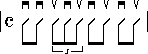
Two triplets
If we have two triplets in a row, we can play them down-up-down-up-down: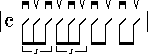
Mind you I say can. Many musicians would call this cheating and insist you do it the hard way.
What's the big deal about picking direction anyway?
I'm glad you asked that question.There are three reasons why I've been insisting you play all the beats with downstrokes and offbeats with upstrokes until now:
- Precision
- The rhythm is the most important aspect of music. No exceptions! With your right hand moving in time with the music, it's much easier to keep the beat.
It's like tapping your foot really, only much more effective. - Emphasis
- The up- and downstrokes doen't sound identical. On a downstroke your hand works with gravity, resulting in a louder tone and stronger emphasis than on an upstroke. Usually you want that emphasis on the beat, not on the offbeat. There are other reasons why up- and downstrokes sound different too: the order the strings are hit obviously, the balance between the strings, the angle between the pick and the strings...
But anyway, the point is: although you can compensate for the difference, nine times out of ten it's better to use it in your music.
That being said, one of the ways to use it is of course to break the pattern. That's perfectly OK as long as you do it on purpose and stay in control. You'd better get the rules down before you start playing around with the exceptions though. - Variation
- Sometimes you want to stick to exactly the same pattern throughout a tune, but more often you want to add some variation - skip a chord here, add one there. With the hand going in a steady motion this is very easy to do. If your basic movement pattern is irregular, it's vistually impossible.