| Main page |
| New visitors |
| Buyer's guide |
| The instruments |
| Technique |
| Lessons |
| Performers |
| Recordings |
| Books |
| Forum |
| Links |
| Site map |
| Site last updated . This particular page was created 16/11/2003 and last updated 28/08/2004 Site updates |
| This site is sponsored by: Apollo's Axes Barnes & Noble.com Jingoloba Music123 Musician's Friend Sheet Music Plus |
What do you do if you have somebody in your band that plays wonderful solo but can't accompany?
The answer is simple: You sack him.
Sounds brutal? Well, chances is that if he can't play backup, he's not really that much of a solo player either. Rhythm is the most important aspect of music - any kind of music, so we better make sure we get it right.
First, let's get the basics down:
Strumming
There are two fundamentally different ways to play chords on a banjo, strumming and picking. Picking is rarely done on an irish tenor banjo, so we'll leave it for now.Strumming means that you strike across all (or at least more than one) of the strings in a single stroke. You can do it with your fingers, but on a banjo you really want to use a pick for it. The basic rules are:
- Hold the pick firmly
- Move you entire lower arm, not just the wrist!!!
- Keep a steady movement
- Relax and let go
Midi files
There are sound examples in midi format for all the rhythm examples here at Irish Banjo so if your computer can play midi files you can hear how they are supposed to sound. Just click on the example you want to hear, and the midi will open in a new window (to make it easier for you to get back to the page). Click on the rhythm example below to see how it works: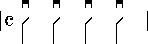
All examples here uses a single chord - a D major - throughout. No need to compicate matters with chord changes. Let's focus on the rhtyhm! (Click here if you're not sure hor to play the D major chord.)
Notation
The notation should be fairly easy to understand, but:If you look at the example above you see it begins with a C. This is the time signature, and the C means there are four beats to a bar.
The vertical lines are barlines, separating the beats of different bars.
The symbols used for notating the music are:
 | Fourth note chord. A chord that lasts one beat. |
 | 8th note chords. Two chords in a single beat. |
 | Fourth note. A single note (that is: play a single string) that lasts one beat. You can find single notes and chords mixed together in any combination, just remember: If it's a rounded notehead, it's a single note, if it's a square notehead or a slash, it's a chord. |
 | Fourth note rest. A rest that lasts one beat. |
 | 8th note chord. A chord that lasts half a beat. |
 | Eight note rest. A rest that lasts half a beat. |
 | Half note chord. Lasts two beats. |
 | Whole note chord. Lasts four beats - that is a whole bar. |
 | Downstroke. Play the chord/note with a downstroke. |
 | Upstroke. Play the chord/note with an upstroke. |