
| Please Read: How to Help Our Site at No Cost to You - Some of our articles contain recommendations for products we like and vendors we personally trust. Some of those vendors may pay us a very small commission if you click on a link and buy their products. This costs you nothing at all and helps offset the costs of what we do. So if we point you to something you decide to buy later, please make certain you come back through our site and click on the link directly. Thanks. |
| This Site is a Cookie-Free Zone - Except for discussion forums that you have to expressly register for, none of our pages use cookies of any kind. Some of the vendors we link to do, but that won't affect you unless you click on a link to their pages. Your continued use of this page indicates that you agree to our policy. For details, click here. |
| Written by Paul Race for Creek Don't RiseTM |



|

Traditional (or "Noter") Appalachian Dulcimer Playing
Though most folks play Appalachian dulcimer a little differently today, I grew up with traditional dulcimer playing.You probably don't have to know this to play dulcimer in most settings today, but it wouldn't hurt to review it so you don't assume that the next person you see playing a dulcimer in the traditional manner is doing it "wrong."
When the Appalachian dulcimer first came to the public's attention (and, frankly, to mine, back in the 1960s):
- The dulcimer usually had three strings. If it had four strings, the two closest to your belly were tuned to the same note, to allow the melody to sound louder than the drone strings.
- Traditional players fretted only the string(s) that were closest to the belly, generally called the "melody string(s)." It was normal to use a small dowel, called a "noter" to push the melody string(s) down. (In fact, some traditional dulcimers didn't even have frets under the other strings.)
- The other strings would be strummed only, providing a drone sound to accompany the melody that was being played. Frankly, it was the sound of the drone strings that attracted me to the instrument's sound in the first place. The middle string would typically be tuned a fourth or a fifth below the melody string(s). The string furthest from the player would typically be tuned an octave, or even an octave and a half below the melody string(s).
- Players would use the diatonic scale to play tunes in various folk "modes" (unusual scales) that are seldom used today. Retuning the instrument to support those modes was considered normal, even if you retuned between every song.
As an example, if the melody string is tuned to D, a traditional dulcimer gives you a major G scale. The scale goes down to D because so many traditional songs in G start on D. ("Amazing Grace," "'Tis the Gift," "Shennandoah," "Red River Valley," and hundreds of others.)
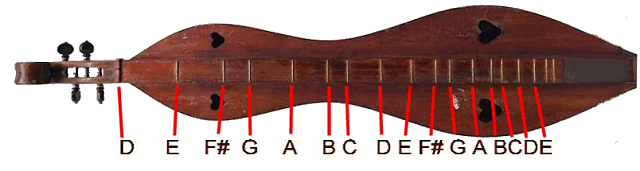
To play a song in G, you could tune:
- The melody string(s) to D above middle C,
- The middle string to the G below that and
- Tune the other drone string to the D below that.
This is called DGD tuning. Of course, you could set your dulcimer up a note lower and play in CFC tuning. In that case the melody string(s) would play an F scale instead of a G scale.
Every dulcimer player from the "hills" had his or her own favorite tunings.
Here's an example of a simple song in the key of G, using DGD tuning, A traditional player would play the melody on the melody strings while strumming all of the strings at the same time. In this case, we've provided both the note names and the fret number to help you play the melody on the melody strings. You would not fret the other strings at all.
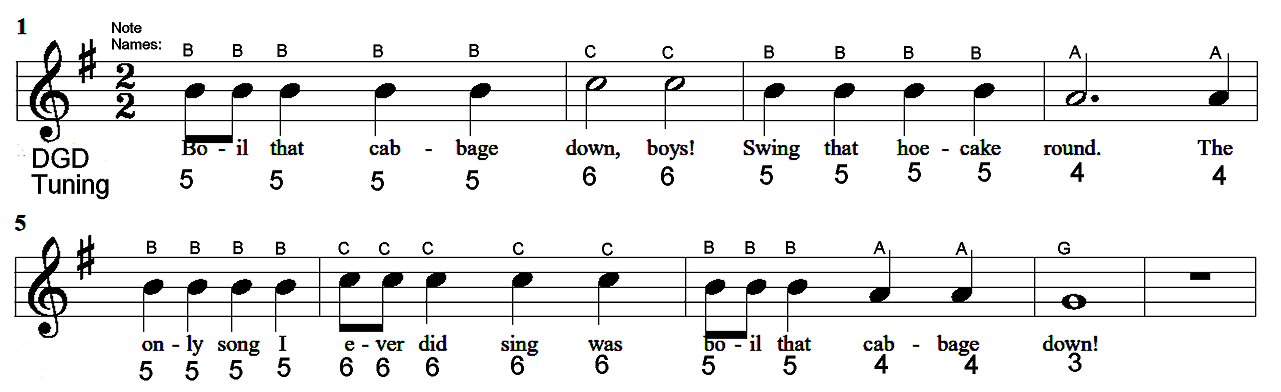
Note: Many, if not most, modern players would play this song in the key of D, using a different tuning, largely because that's the favorite key of most dulcimer clubs.
For more information about playing in the key of D, please see our article on Modern Appalachian Dulcimer Playing
Minor Keys - What if you wanted to play a song in a minor key? A dulcimer with the melody string(s) tuned to D has two minor scales built in - E minor and A minor. Both scales are based on tunings that go back to the Middle Ages, called "modes," or sometimes "modal scales." Only a few of those scales survive in modern music, but they were at the heart of many ancient ballads played on traditional dulcimers and similar instruments a century or eight ago.
If your melody string is tuned to D, the E minor scale begins on the second fret. Musicians call this Em scale a "natural minor" or "Aeolian mode." To play a tune in E minor, you would typically
- Leave the melody string(s) in D,
- Tune the bass string up to E and
- Raise the middle string to B (or if you're afraid of breaking it, lower it to E).
One song that works well in this mode is "God Rest Ye, Merry Gentlemen."
Another minor-sounding mode is related to A minor. If you tried to play an A minor with the melody string(s) tuned to D, you'll notice that one of the notes (F#) doesn't sound quite right. That's because you're playing in "Dorian mode," using another scale that goes back to the Middle Ages. If you lived in Appalachia a century ago, chances are you knew or knew someone who knew songs in that mode. (Outsiders often say such modes contribute to a "haunting" melody.) To play a tune in A minor (Dorian mode), you would typically
- Leave the melody string(s) in D,
- Tune the bass string up to E and
- Raise the middle string to A.
One song that works well in this mode is "Are You Going to Scarborough Fair?"
Mixolydian, Another Popular Mode If you tuned your dulcimer to, say, DAD, and played a song in the key of D, you'd notice that you have a C where you'd expect a C#. No problem - you're in "Mixolydian" mode, using a scale that's still in common use today. (Folk songs like "Old Joe Clark" and "Shady Grove" were played in mixolydian mode up until about 1950. Many rock and pop songs still use that mode. One of my favorite Folk-era songs in Mixolydian mode is "If I were a Carpenter."
What's With All the Retuning? Modern dulcimer players tend to select one tuning and stick with it, even if they have to use devices called "capos" to play in other keys. But a century ago, nobody had access to digital tuners, and everyone who was serious about a musical instrument tuned by ear. Most guitar and banjo players of my generation can still do so, and many of us can tune faster that way than the average person using a digital tuner. As far as retuning one or two strings goes, watch a professional acoustic guitar player go to "drop D tuning" and back sometimes. Some of them can do it without missing a beat.
A century ago, retuning your dulcimer to change keys or modes was as common as snapping a capo on or off a guitar is today, and many dulcimer players could do it almost as fast.
Next Steps
One of the best ways to learn more about traditional playing is to track down the Jean Ritchie book below. For more playing tips and styles than that book contains, nearly any other Appalachian dulcimer book published before 1980.
Though I have an Amazon link below, please feel free to track down used books from other sellers - they may be much cheaper, and some are only available that way.
Also, if there's a particular song you need to play and you don't mind going to DAA or DAD, you can always download a "tablature" for the song in question, tune your dulcimer the way they did but ONLY play the melody string (unless you need to jump to the middle string for a low note). You can see a bigger picture by clicking on the staff.
As an example, here is the kind of tabulature you might see for "Boil That Cabbage Down" on a DAD site.
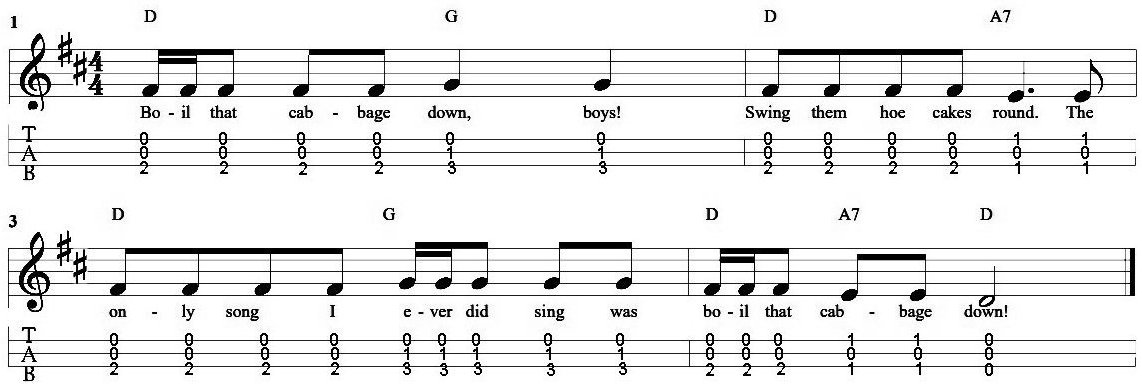
The three lines below the staff represent the strings on your dulcimer. The bottom line represents the melody string(s). The little numbers represent which fret you push down with your left hand.
To play this song in traditional or "noter" style, just ignore the numbers on the other two strings.
About Jean Ritchie
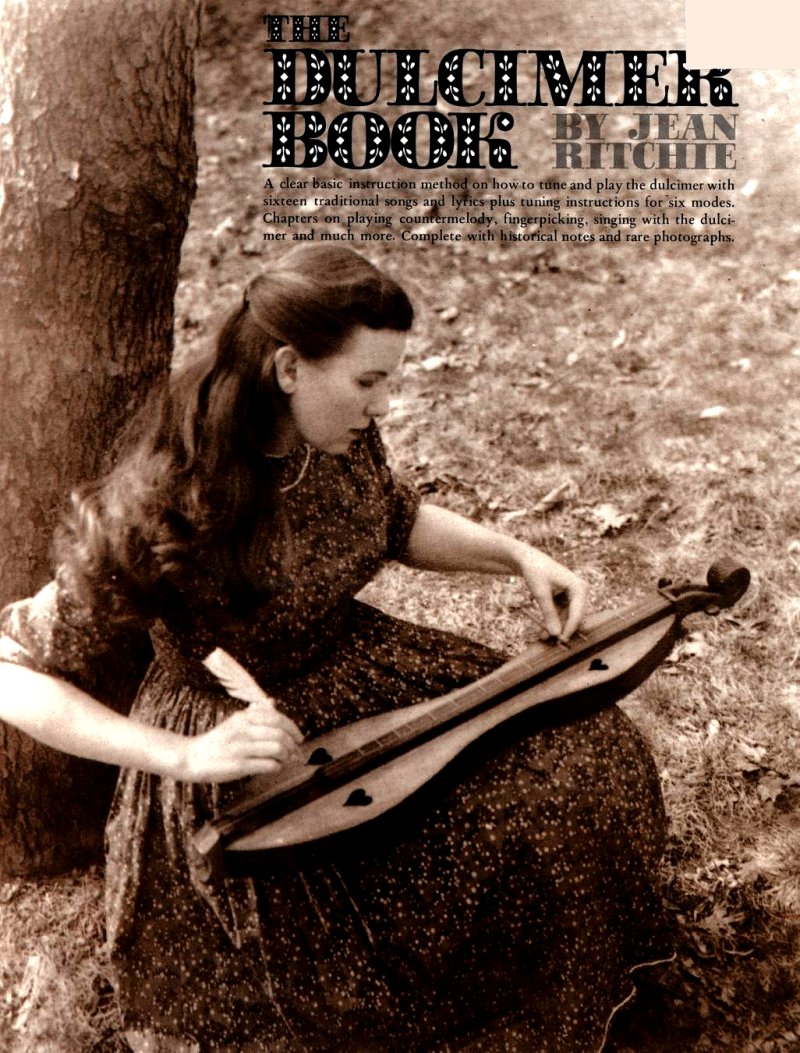 Back in the 1960s when the Appalachian dulcimer was first coming to priminence, no one researched, played, or wrote about it more than Jean Ritchie.
By default, her playing style was as authentic as it could get. It's also the way I grew up playing dulcimer "back in the day."
Today, however, most people play dulcimers a little differently, so this book may only be helpful if you need to "get to the root" of the matter. That said, I have all of Ritchie's writing that I could get my hands on, and I regard them as an important part of my reference library.
If you want to see this book on Amazon, click here.. That said, there's not much call for these books among modern players so they turn up on used book web sites from time to time. They may be cheaper, even considering shipping charges.
What Happened to Traditional Ducimer Playing Styles?
As Appalachian dulcimer edged toward the Folk mainstream, most of the old modal ballads that it supported did not. New players, especially those who picked up the instrument from 1970 on wanted to play more modern songs in more modern styles. As result,- Songs that used unusual "modes," such as the Dorian mode described above either fell by the wayside or were changed to fit into modern keys.
- Additional frets were added, to make it easier to play in D major, a popular Folk and Country key.
- Most dulcimer clubs and jams, needing to standardize so everyone could play along, settled on playing most songs in the key of D (using DAD or DAA tunings).
- Playing chords (instead of leaving the "drone strings" open) became common.
- Widespread use of "tablature" helps people learn new songs and join in.
Personally, I still appreciate traditional songs, traditional playing, and traditional instruments. But the changes described above have helped hundreds - if not thousands - of new players join in the fun.
For an overview of the ways how most people play Appalachian dulcimer today, click here.
Other Resources
As we add articles and "vet" other resources that you may find helpful, we will be adding them here.
- Appalachian Dulcimer - History - Sorts out theories of the Appalachian Dulcimer's pre-20th-century evolution, and goes on to describe how the dulcimer and it's uses have changed since the Folk Revival helped bring it into public notice.
 Appalachian Dulcimer Buyer's Guide - describes features and materials you should consider looking for when shopping for a dulcimer.
I have to warn you, though, we don't say much about where to get Appalachian dulcimers, as the best ones are all made in private shops that come and go. But there are tips about what to look for in your search.
More to Come
There is much to know about these instruments, and we won't be able to do more than "scratch the surface," but people do keep coming to us with questions, so we plan to use this page as a place as an index to future articles.Stay tuned!
 Whatever else you get out of our pages, I hope you come away with some great ideas for "sharing the joy."
And please stay in touch!
- Paul Race


All material, illustrations, and content of this web site is copyrighted ? 2001, 2002, 2003, 2004, 2005, 2006,
2007, 2008, 2009, 2010, 2011, 2012, 2013, 2014, 2015, 2016, 2017, 2018, 2019, 2020, 2021, 2022, 2023, 2024, 2025, 2026 by Paul D. Race. All rights reserved.
Creek Dont' Rise(tm) is a participant in the Amazon Services LLC Associates Program, an affiliate advertising
program designed to provide a means for sites to earn advertising fees by advertising and linking to Amazon.com.
For questions, comments, suggestions, trouble reports, etc. about this page or this site, please contact us.
| Visit related pages and affiliated sites: | |||||
| - Music - | |||||

|
 |
 |

|
|

|

|

|

|

|

|

|

|

|

|

|

|

|
| - Trains and Hobbies - | |||||
 |

|

|  |
 |

|
| - Christmas Memories and Collectibles - | |||||
 |

|
 |

|
 |

|
| - Family Activities and Crafts - | |||||
 |

|

|

|

|

|