
| Please Read: How to Help Our Site at No Cost to You - Some of our articles contain recommendations for products we like and vendors we personally trust. Some of those vendors may pay us a very small commission if you click on a link and buy their products. This costs you nothing at all and helps offset the costs of what we do. So if we point you to something you decide to buy later, please make certain you come back through our site and click on the link directly. Thanks. |
| This Site is a Cookie-Free Zone - Except for discussion forums that you have to expressly register for, none of our pages use cookies of any kind. Some of the vendors we link to do, but that won't affect you unless you click on a link to their pages. Your continued use of this page indicates that you agree to our policy. For details, click here. |
| Written by Paul Race for Creek Don't RiseTM |


|
Modern Appalachian Dulcimer Playing
Appalachian dulcimers came to the notice of countless Folk Revival musicians in the 1960s. Intially the focus was on playing traditional tunes in the traditional manner described in our article "Traditional Appalachian Dulcimer Playing. There are still folks who play dulcimer that way - after all, it goes back centuries. So don't make fun if you come across one.
But countless adopters were more interested owning an instrument that seemed easy to play than they were in learning the traditional old modal tunes it was built to support. One of the first accommodations was to reconfigure that fretboard.
Frankly, many purchasers from outside the Folk tradition were confused by the diatonic tuning. If your melody string was tuned to D and you tried to play a scale by starting at the lowest, open position of the melody string, it didn't sound right when you hit that C. After all, a D scale should have a C#, shouldn't it? Never mind that the instrument was actually designed to play a G scale on that string.
So dulcimer builders started offering an extra fret as an option. It would be squeezed between the sixth fret and the seventh fret, so it is usually called the "six-and-a-half" fret. If you want a C# in the higher octave, you add a "thirteen-and-one-half" fret.
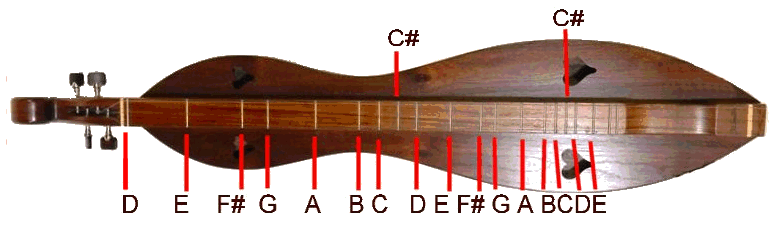
Within a few years, those extra frets became standard. Sadly, many dulcimer players born since, say 1970, consider traditional dulcimers (without the 6.5 fret) deficient, no matter how well they are built, how great they sound, or how well their owners can play them.
For a time, other variations were rampant. You still come across dulcimers with custom setups, but, fortunately, most can be reset to the setup you're familiar with simply by restringing.
Club Tunings
With the rise of dulcimer clubs and jams, players felt the need to have a standard way of playing so everyone would be playing the same notes or chords at the same time.
Two common tunings emerged:
- DAD, which pretty much depends on having the 6 1/2 fret.
- DAA, which helps you play songs in D without a 6 1/2 fret
Some clubs standardized on DAD, some clubs standardized on DAA, and handful of clubs standardized on other setups.
Because DAD clubs seem to outnumber DAA clubs, our following examples will use DAD tuning. That is:
- The bass note (farthest from your belly) is tuned to D below midde C.
- The middle string is tuned to A below midde C.
- The melody string is tuned to D above middle C. (If there are two melody strings, they are tuned the same.)
If your club uses DAA tuning, just tune the melody string(s) down to the same note as the middle string.
(Personally, I prefer DGD tuning, which almost nobody uses, so I don't have a dog in the DAD vs DAA fight.)
Chords
Most folks who play in dulcimer clubs are learning chords that go with their club's tuning.Three common chords used in DAD tuning are shown below. The little circles show where you should push down the strings to make those chords.

In full disclosure, most dulcimer chords don't have all the notes you would use to play the same chord on guitar or piano. For that reason, the D chord shown (with no strings fretted) can stand in for D7 or Dm. The A chord shown can stand in for A7 or Am. This doesn't apply to all chord shapes, though.
Two versions of the G chord are shown, because the second chord is often used when the melody string is playing a G note.
To play chords while playing melody, you will have to choose a chord shape that has the melody note on the melody string, but you also fret one or both of the other strings. Yes, this sounds complicated, but many other folks have done the work for you, by writing out a sort of "cheat sheet" call a "tabature," "tab" for short.
Tablature
One advantage of sticking with DAD or DAA is that many players have written out "tablature," little horiontal charts that show you how to play the melody and chords for songs.
The example below shows the DAD tablature for a simple song. The three lines beneath the staff represent the three strings of an Appalachian dulcimer (If yours has two melody strings, you treat them as one string.) The string on the bottom represents the melody string(s), the closest string(s) to your belly.
The little numbers show where you fret each string. You actually press down a little "behind" the fret, not on it. You want the string to come down on the metal fret cleanly. Yes, it may hurt your fingertips at first. But it gets better the more you practice. Maybe 20 minutes the first few days, then your callouses will build up and you'll be able to practice longer.
To see a bigger version, click on the picture.
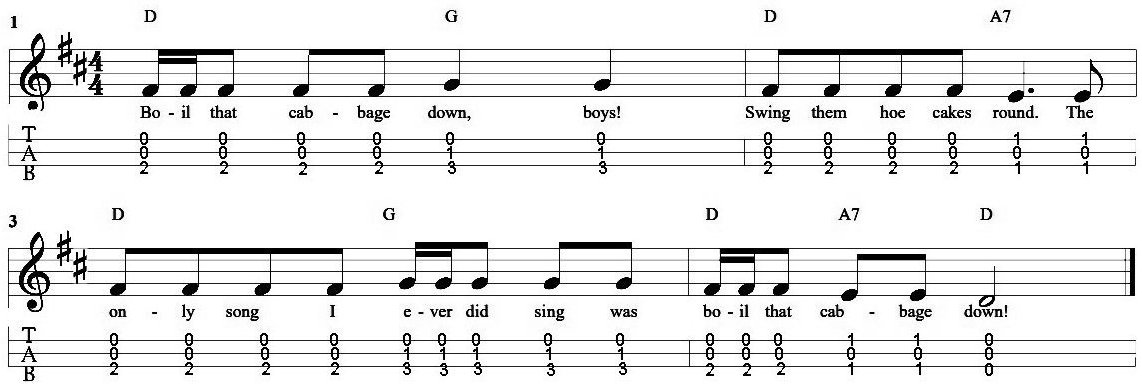
If you have a tab, you can generally ignore the chord names, since they're already built into the tab. But if you're making up your own arrangement, you'll find them helpful.
Here's a few verses, if you don't already know about 30, like the old-timey string bands did:
- Once I had a muley cow, Muley since she's born, Took a jaybird half a month To fly from horn to horn.
Wish I had a needle and thread, Fine as I could sew. I'd sew my gal to my coat-tail and down the road I'd go.
Once I had a bicycle, Learned to ride it well, Crashed into a telephone pole, And broke it all to pieces.
If you need more verses, you can borrow them from "Shady Grove," "Cindy, Cindy," "Old Joe Clark," and a dozen other barn dance songs.
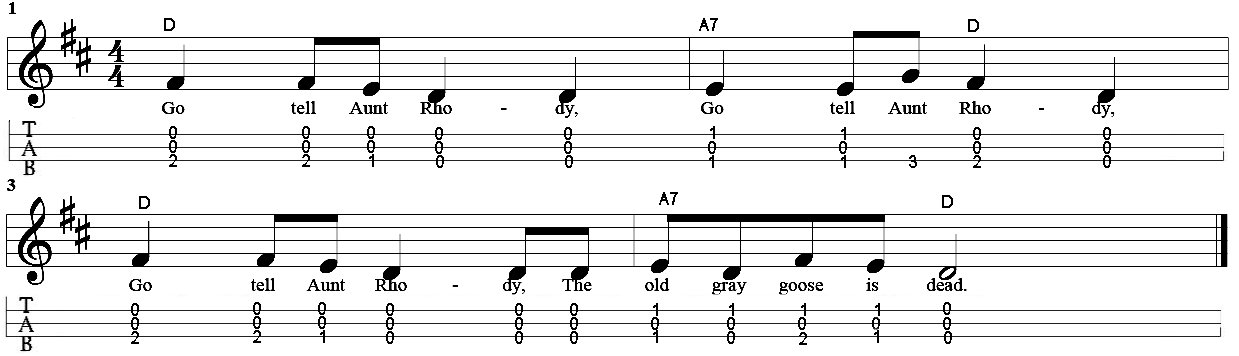
Here's another simple tune - the only difference is that sometimes the melody note changes within the chord. A melody note that doesn't fit the chord isn't a problem - it's called a "passing tone," and you just have to figure out how to adjust your chord fingering for that beat or two. On the other hand, it's traditional to play this tune very slowly, so that makes it easier.
Again, if you need it bigger, click on the picture.
Other verses include:
The one she's been saving (3x) to make a feather bed.
She did last Sunday (3x) standing on her head.
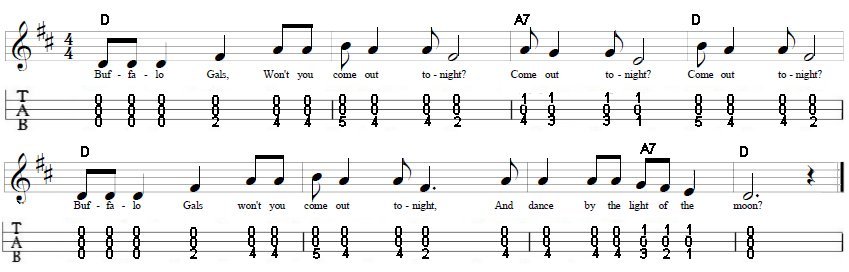
Here's another song that only has two chords, technically, but has a trickier beat:
Other verses include:
As I was walking down the street, down the street, down the street,
A pretty young girl I chanced to meet, and she was fair to view.
I danced with a dolly with a hole in her stocking, and her toes kept a rocking and her knees kept a knocking.
I danced with a dolly with a hole in her stocking, and we danced by the light of the moon.
One of my favorite tunes also adapts well to these chords:
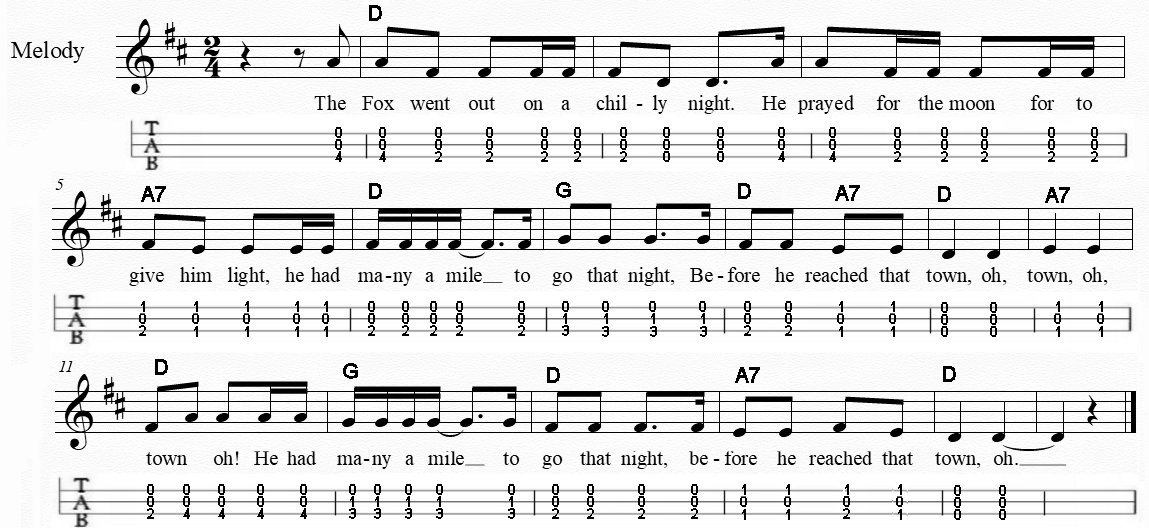
Here are some more verses. There are others out there, and many versions of each.
- He ran 'til he came to a great big pen. The ducks and geese were kept therein.
He said, "A couple of you are going to grease my chin, before I leave this town, oh" etc.
He grabbed the gray goose by the neck, Flung the duck across his back.
He didn't mind the "quack, quack, quack," and the legs all dangling down-oh, etc.
Old mother Flipper Flapper jumped out of bed. Out of the window she cocked her head.
She said, "John, John, the gray goose is gone, the fox is on the town, oh, etc.
He ran 'til he came to his cozy den. There were the little ones, eight, nine, ten.
They said "Daddy you'd better go back again, 'Cause it must be a might fine town - oh, etc.
Dig a Little Deeper
All of the tunes so far have played only notes you can play on the melody string(s). But tens of thousands of Folk, Pop, Country, and Bluegrass songs in the key of D need a note below D. On a DAD dulcimer, you play that note by bypassing the melody strings and playing on the middle string (or the middle string and the bass string).
In the following arrangement, when the melody goes lower than you can play on the melody strings, you play those notes on the middle string. This may seem cumbersome at first, but you'll discover that thousands of Folk songs work this way, incuding "Shennandoah," "Red River Valley," "'Tis the Gift," and many more.
Once you get the hang of bouncing to the middle string for songs like this, you're ready to take on hundreds of other songs.
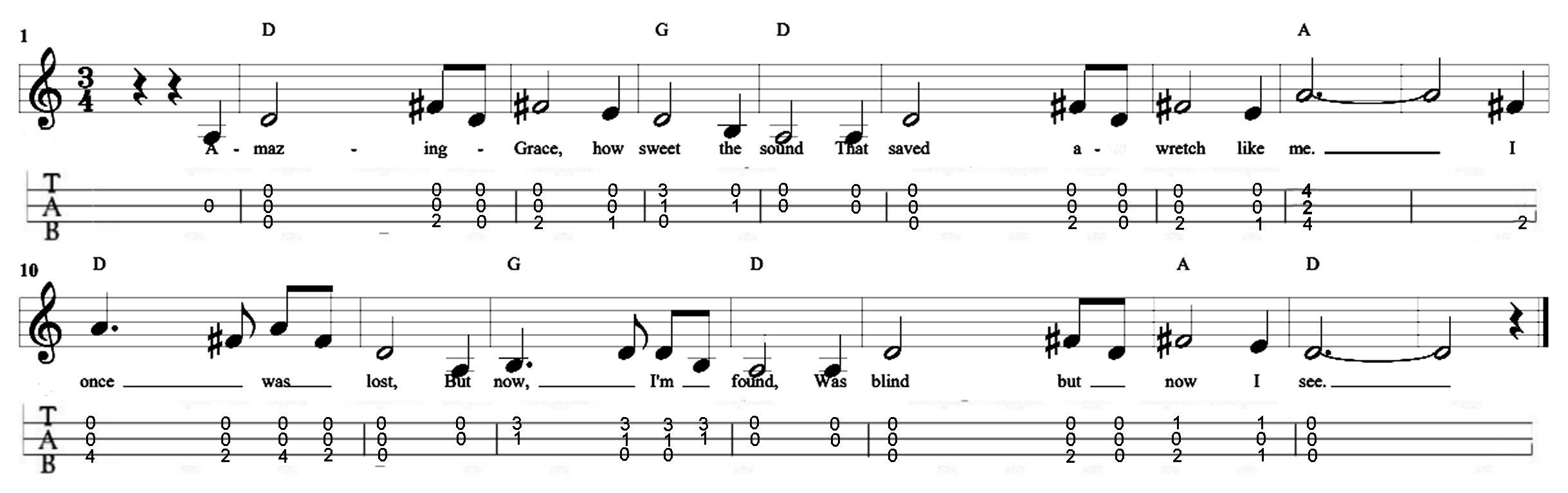
Other verses include:
- 'Twas grace that taught my heart to fear, and grace my fears relieved.
How precious did that grace appear, the hour I first believed.
Through many dangers, toils and cars I have already come.
'Tis grace that brought me safe thus far, and grace will lead me home.
When we've been there ten thousand years, bright shining as the sun,
We've no less days to sing God's praise than when we've first begun.
Note: - in most Folk, Bluegrass, and church environments, this song is played in G. We're putting it in D because that's the way DAD dulcimer clubs usually play it. Feel free to play it however you want to.
Here's another of my favorites for singing in Folk and Bluegrass jams. Left to my own resources, I usually play it in G, but DAD clubs will play it something like the way I show below. Click on the staff to see it larger.
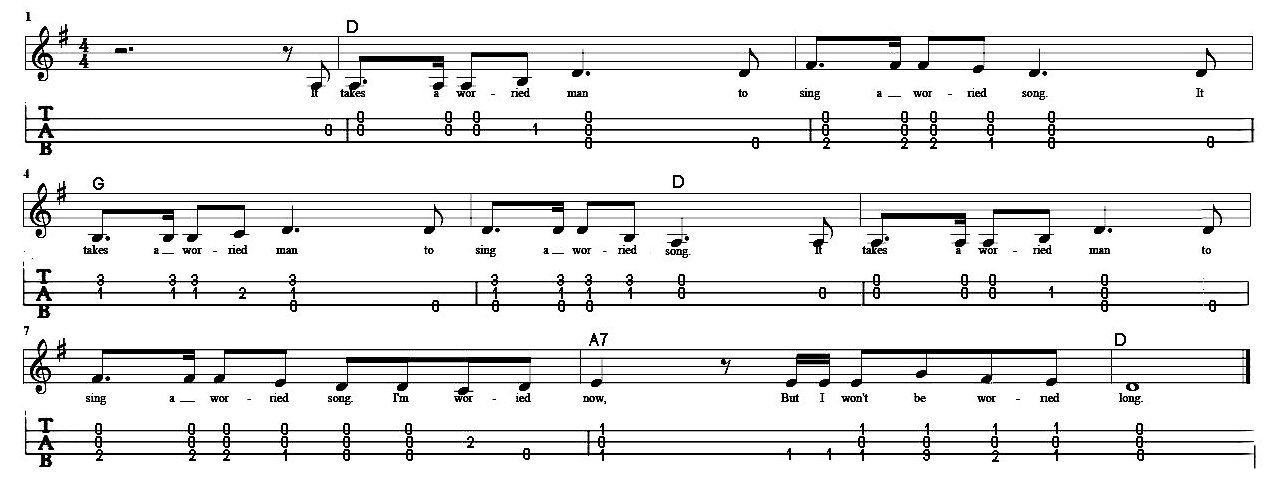
Popular verses include:
- I went across the river, and I laid down to sleep (3x). When I woke up, had shackles on my feet.
29 links of chains upon my leg (3x), And on each link, the initials of my name.
I asked of that judge what would be my fine (3x), Twenty-nine years, on the Rocky Mountain line
The longest train I ever saw was a hundred coaches long (3x). My own true love was on that train and gone.
Note: Many modern Bluegrass artists only sing the first line twice, "leaving out" the third line. I've been told I was singing it "wrong," by singing the four-line version. But I've heard early recordings of people like Flatt & Scruggs and Maybelle Carter singing that version. I've also heard at least one later recording of Flatt & Scruggs singing the three-line version. In other words, they're both "right." If you're going to lead this song in a jam or such, you should probably announce which version you're going to do before you start.
About the C# - Is Your Dulcimer "Missing" a Fret?
So far ALL of the songs we've used have avoided the "elephant in the room," so to speak. Many songs in the key of D require a note that older dulcimers may lack. If you're playing a song in the key of D with the melody string(s) tuned to the key of D, you'll "need" a high C# for many tunes.
Sadly, some dulcimer players who took up the instrument in the last foty years, will "fret-shame" you if your dulcimer doesn't have the fret you "need" to play that note. Starting in the late 1970s, adding the extra fret became standard by 1985.
Once again, here's a photo of a modern dulcimer you'll see the C#s squeezed in between the Cs and the Ds. Because the lower of the two add-on frets is between frets 6 and 7, it's usually called the "six-and-one-half" fret. Most modern dulcimers that have a 6 1/2 fret also have a 13 1/2 fret to get the highest C# in there, but that's not universal.
If you're dulcimer shopping, and you see four frets that are very close together near the middle of the fingerboard, that's a sign that the instrument has the 6 1/2 fret.
On the other hand, if your instrument lacks a 6 1/2 fret, it is not defective; it is classic! I have classic dulcimers that will outplay almost anything on the market today.
Don't feel bad or let other people make you feel bad. We used the DAD examples because so many dulcimer clubs play this kind of dulcimer in this style with this sort of tabs. But traditional dulcimer players tune however they want, and ignore anyone who claims that the only "right" way to play Appalachian dulcimer is a method invented several centuries after the instrument was invented.
On the other hand, if you want to play in a club that uses DAD tuning and tabs, you'll probably need that extra fret. (Unless you have a DAA club, then you don't really need it after all; unfortunately that explanation is beyond the scope of this article. If we get a lot of response maybe we'll do a DAA version.)
At this point, folks whose dulcimer doesn't have the add-on fret(s) still have options.
- Find a local guitar luthier who can put the extra fret on. Current cost in most of the US is in the $50 range.
- Restring your dulcimer for DAA and start using DAA tabs.
- If you're jaming in a DAA club, just skip the C#s when they come along. Or try playing an E (eighth fret) or A (fourth fret) when they come alomg. Chances are your harmonies will work with what everyone else is playing.
- Go Your Own Way - If you already know music theory and play other instruments, it's not hard to figure out a dozen different ways to play your dulcimer and choose the way that works the best for you.
Going Your Own Way
I came to Appalachian dulcimer back when "traditional" or "noter" playing was universal, but I had already learned the basics of music on other instruments, including saxophone, guitar, and banjo (not to mention a very frustrating piano class). Because I work a lot in Folk and "String Band" genres, I tended to play my dulcimer in the key of G, using DGD tuning and making up my own chord shapes. I've only learrned DAD chord-style playing because folks who left my clinics and joined a DAD club experienced cognitive dissonance - and sadly, sometimes ridicule - for playing dulcimer in traditional ways that have largely fallen by the wayside.Unfortunately, DGD resources are hard to come by. But most dulcimer books that were written before 1980 show traditional methods of playing that do not rely on the 6 1/2 fret. And many of them show ways to use alternative tunings for certain kinds of songs that - frankly - the dulcimer clubs never play.
If you have past musical experience, you may be able to figure out a way to play dulcimer that works best for you. After all, guitar players experiment with alternative tunings all the time, and nobody accuses them of doing it "wrong."
Conclusion
This is just and introduction to get you used to the instrument and one of the most common ways of playing.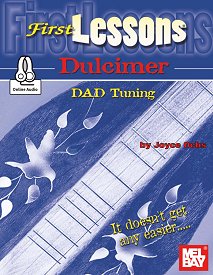 If it's practical for you to stick with DAD tuning, you'll find that Joyce Ochs' "First Lessons Dulcimer: DAD Tuning" book goes into much more detail than I did here, and goes way beyond what I had room to show.
If you'd rather
Other Resources
As we add articles and "vet" other resources that you may find helpful, we will be adding them here.
- Appalachian Dulcimer - History - Sorts out theories of the Appalachian Dulcimer's pre-20th-century evolution, and goes on to describe how the dulcimer and it's uses have changed since the Folk Revival helped bring it into public notice.
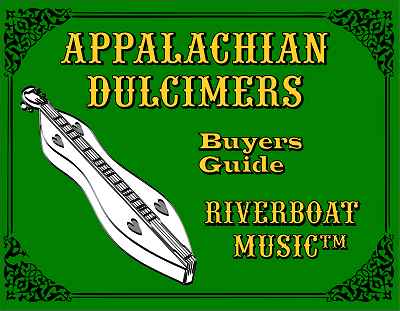 Appalachian Dulcimer Buyer's Guide - describes features and materials you should consider looking for when shopping for a dulcimer.
I have to warn you, though, we don't say much about where to get Appalachian dulcimers, as the best ones are all made in private shops that come and go. But there are tips about what to look for in your search.
More to Come
There is much to know about these instruments, and we won't be able to do more than "scratch the surface," but people do keep coming to us with questions, so we plan to use this page as a place as an index to future articles.Stay tuned!
 Whatever else you get out of our pages, I hope you come away with some great ideas for "sharing the joy."
And please stay in touch!
- Paul Race


All material, illustrations, and content of this web site is copyrighted ? 2001, 2002, 2003, 2004, 2005, 2006,
2007, 2008, 2009, 2010, 2011, 2012, 2013, 2014, 2015, 2016, 2017, 2018, 2019, 2020, 2021, 2022, 2023, 2024, 2025, 2026 by Paul D. Race. All rights reserved.
Creek Dont' Rise(tm) is a participant in the Amazon Services LLC Associates Program, an affiliate advertising
program designed to provide a means for sites to earn advertising fees by advertising and linking to Amazon.com.
For questions, comments, suggestions, trouble reports, etc. about this page or this site, please contact us.
| Visit related pages and affiliated sites: | |||||
| - Music - | |||||

|
 |
 |

|
|

|

|

|

|
|

|

|

|

|

|

|
|

|
| - Trains and Hobbies - | |||||
 |

|

|  |
 |

|
| - Christmas Memories and Collectibles - | |||||
 |

|
 |

|
 |
|
| - Family Activities and Crafts - | |||||
 |

|

|

|
|
|